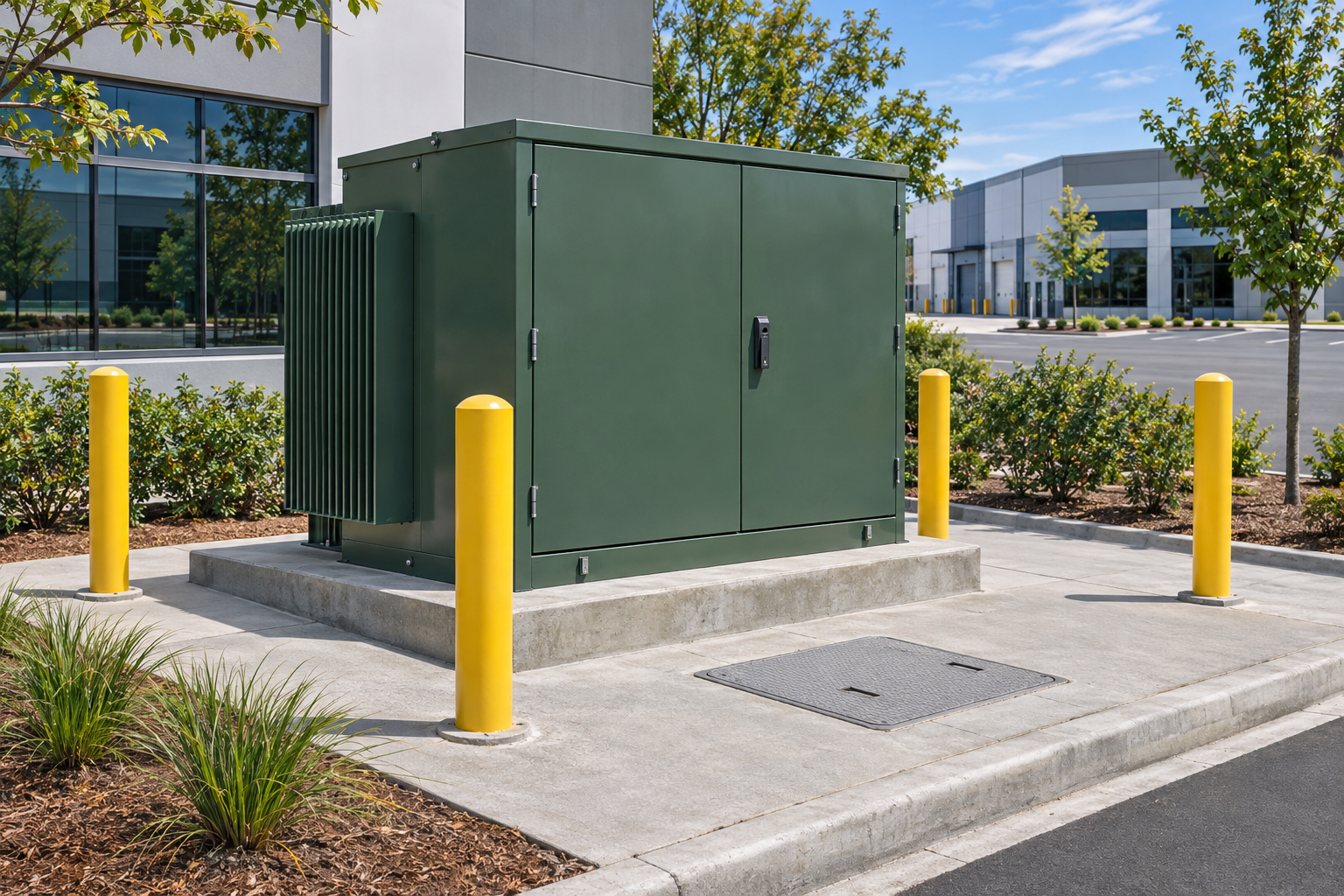
Pad-mounted transformers are widely used where commercial and industrial campuses distribute medium-voltage power through underground cables. Their enclosed construction supports ground-level operation, but the surrounding civil layout determines whether installation, inspection and replacement can be performed safely.
A successful layout connects electrical ratings with traffic protection, cable routing, drainage, security and utility access. These decisions should be settled before the foundation and underground duct bank are poured.
Start with Feed Arrangement and Service Access
The team should confirm radial or loop feed, live-front or dead-front terminations, switching requirements and the side from which technicians will operate the cabinet. Door swing and working space must remain clear after landscaping, fences and parking spaces are installed.
Replacement planning matters as much as routine access. The route must support a delivery vehicle, lifting equipment and removal of the complete transformer without demolishing permanent site features.
Campus Layout Checklist
Coordinate the concrete pad, anchoring, grounding grid and finished grade with the approved transformer drawing.
Protect the enclosure from vehicles with correctly positioned bollards that do not block doors or lifting access.
Keep stormwater, irrigation and roof drainage away from cable compartments and the transformer foundation.
Separate primary and secondary duct banks and respect cable bending radius at every termination.
Preserve ventilation openings, oil-containment provisions and required clearances from buildings and combustible materials.
Reserve space for future feeders or a higher-capacity replacement when campus load growth is expected.
Match the Transformer to the Campus Load
Commercial campuses often combine HVAC, elevators, lighting electronics, EV charging, workshops and office loads. Diversity can reduce coincident demand, while motor starting and rapid charging can create short-duration voltage-drop concerns.
The specification should define kVA, voltage ratio, impedance, tap range, efficiency, sound level, protection and the required cable interfaces. A coordinated load study gives the manufacturer enough information to select the enclosure and internal arrangement correctly.
Next Step
For outdoor underground distribution, SOVIN’s Transformateur sur socle ZGS série II can be configured around the required voltage, capacity and feed arrangement. Share the single-line diagram and site plan before civil work is released.
Technical reference: IEEE C57.12 series requirements and the applicable local utility construction standard.
Comparez les transformateurs au sol et les transformateurs sur poteau en fonction de leur installation, de leur sécurité, de leur capacité, de leur entretien et de leur application afin de choisir la solution de distribution la mieux adaptée.
Fast-charging networks are increasing both the number and the power rating of public charging points. The International Energy Agency’s Global EV Outlook 2026 reports that fast and ultra-fast chargers grew from 1.5 million in 2024 to 2.2 million i...
La demande mondiale en électricité connaît une accélération en 2026-2027. Découvrez pourquoi le rendement des transformateurs, la capacité du réseau, la définition précoce des spécifications et la planification coordonnée des appareillages de commutation sont essentiels pour les nouveaux projets énergétiques.
Underground distribution is growing in cities and new developments, but pole-mounted transformers remain an efficient solution for many rural and low-density networks. They use the existing overhead route, require little ground space and can be in...
 Catégories à la une












Envoyer une demande de renseignements sur un produit
Nous vous contacterons dans les 24 heures.