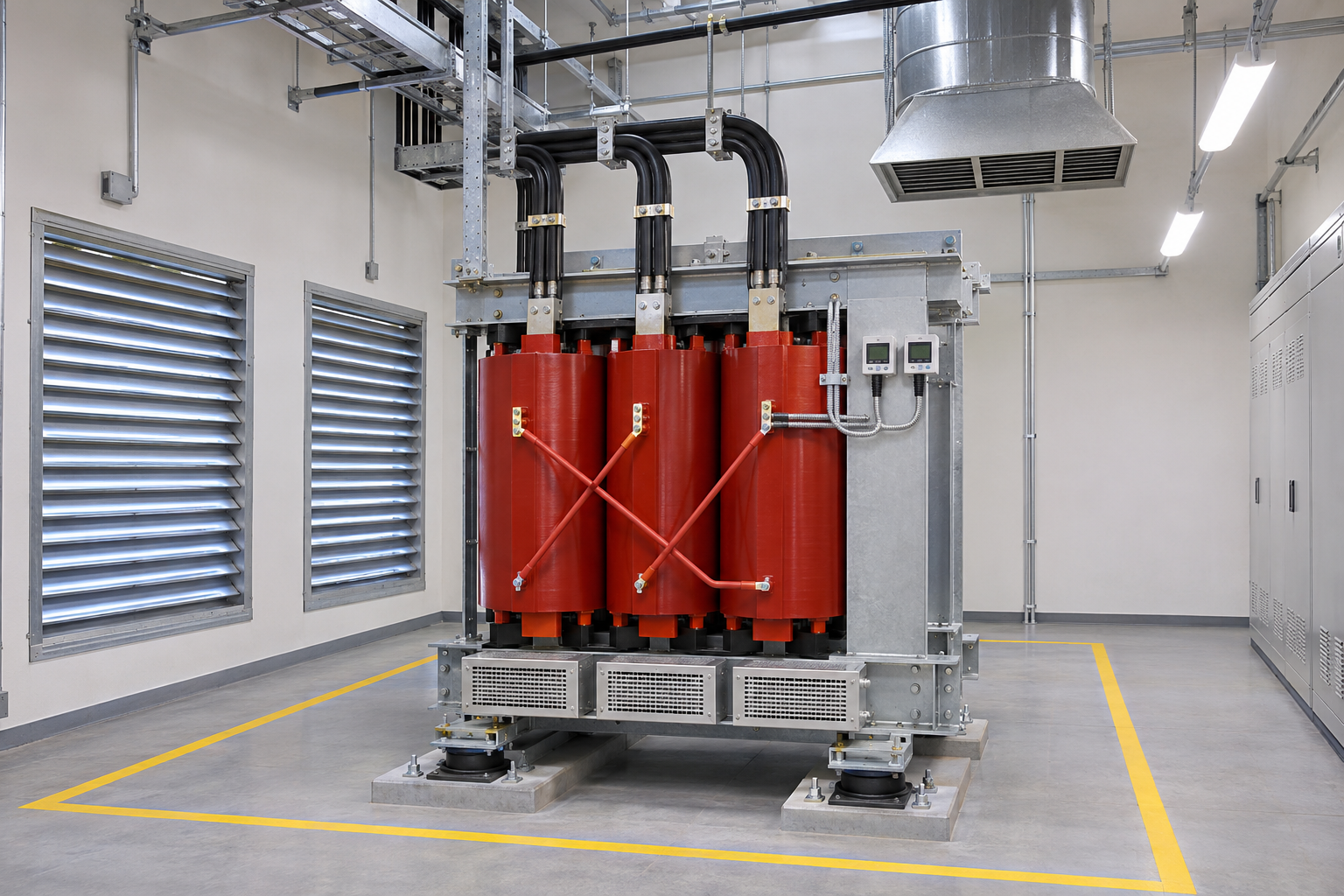
A dry-type transformer may be rated correctly on paper and still run hotter than expected when the surrounding electrical room cannot remove its losses. Continuous loading, electronic equipment, high ambient temperature and restricted airflow can reduce thermal margin and shorten insulation life.
Ventilation should therefore be treated as part of the transformer system, not as a late architectural detail. The room, enclosure, air path, sensors and operating controls must work together under normal duty and credible fault or fan-outage conditions.
Heat Removal Begins with the Real Load Profile
The ventilation calculation should use guaranteed transformer losses at the expected loading range, plus heat released by nearby switchgear, UPS systems, drives and cable conductors. A nameplate rating alone does not describe how much heat the room must reject.
Harmonic-rich loads can increase winding and stray losses even when the RMS current appears acceptable. Project teams should identify nonlinear loads early and confirm whether extra thermal capacity, forced-air cooling or a different transformer design is required.
Five Room-Design Checks
Maintain the manufacturer’s minimum clearance around coils, enclosure panels, air inlets and service access points.
Place cool-air inlets low and exhaust openings high so the room supports natural convection instead of recirculating hot discharge air.
Calculate room heat gain for the highest credible ambient temperature and loading condition, not only the annual average.
Define fan redundancy and alarm behavior where forced ventilation is essential to carrying the required load.
Install winding and room-temperature monitoring with alarm thresholds linked to operating procedures.
Coordinate the Transformer and Building Systems
Airflow can be compromised by fire dampers, filters, acoustic treatment, security louvers or later equipment additions. The final arrangement should be reviewed by electrical, mechanical and fire-protection teams using the same heat-loss assumptions.
Commissioning should include airflow direction, fan operation, alarm verification and a baseline temperature record under representative load. This gives maintenance teams a useful reference for identifying blocked filters, failed fans or abnormal heating later.
Next Step
For indoor distribution projects, room ventilation and transformer selection should be finalized together. Review SOVIN’s three-phase dry-type isolation transformer and provide the load profile, ambient conditions and room layout for a project-specific configuration.
Technical reference: IEC 60076-11, Power transformers – Dry-type transformers.
Les centres de données ont besoin d'une distribution électrique stable, efficace et facile à entretenir pour assurer un fonctionnement continu. Ce cas d'application présente une solution pratique utilisant un transformateur de type sec pour un local électrique intérieur, en accordant une attention particulière aux caractéristiques de la charge,...
Avant de définir les spécifications de votre projet, comparez les transformateurs à sec et à bain d’huile en termes de refroidissement, d’installation, d’entretien, de sécurité incendie, de rendement et d’application.
Les délais de livraison des transformateurs et les chaînes d'approvisionnement du réseau électrique resteront des facteurs importants en 2026. Passez en revue les caractéristiques électriques, les conditions d'installation, le rendement, la certification et la documentation que les acheteurs doivent vérifier avant de passer commande.
En tant qu’équipement courant de gestion de la distribution électrique, le disjoncteur est indispensable dans presque tous les domaines de consommation d’énergie. À mesure que la ville continue de se moderniser, les disjoncteurs sont constamment mis à jour. Avec l’essor de l’Internet des objets, a...
 Catégories à la une












Envoyer une demande de renseignements sur un produit
Nous vous contacterons dans les 24 heures.