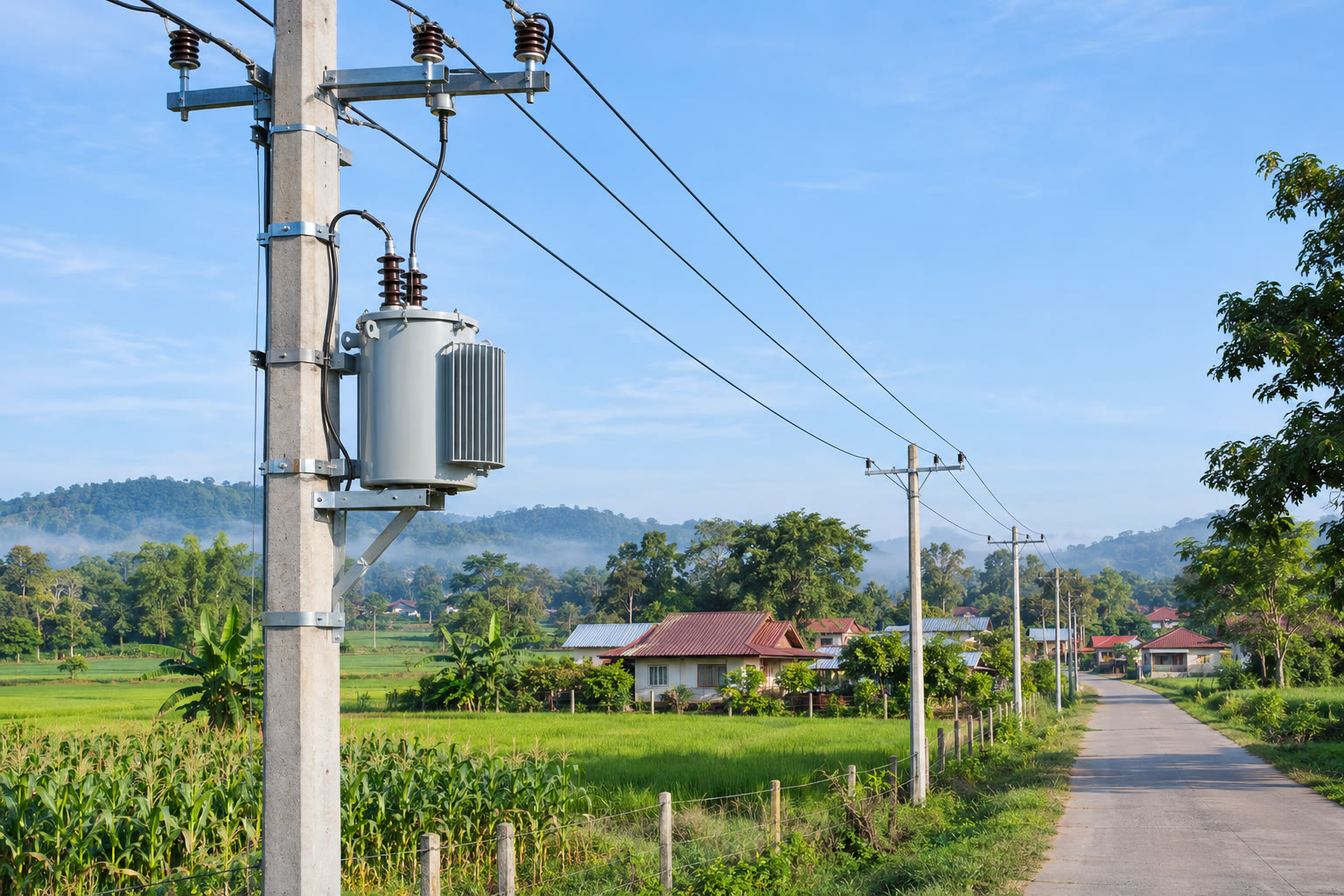
Underground distribution is growing in cities and new developments, but pole-mounted transformers remain an efficient solution for many rural and low-density networks. They use the existing overhead route, require little ground space and can be installed close to dispersed loads.
Rural design still requires careful engineering. Long feeders, lightning exposure, seasonal demand and limited maintenance access influence voltage regulation, protection and the number of transformer points along the line.
Plan Around Load Density and Feeder Length
A few large transformers may simplify inventory, but long low-voltage circuits increase voltage drop and conductor losses. More frequent smaller units can shorten secondary runs and improve voltage at remote customers.
The design should consider current demand, productive-use growth, irrigation or agricultural motors, community services and future connections. Load diversity is helpful, but motor starting and evening peaks can still govern voltage performance.
Protection and Environmental Checks
Coordinate primary fuses with transformer inrush, downstream faults and upstream recloser operation.
Select surge arresters and grounding for the local lightning exposure and soil conditions.
Confirm pole strength, transformer mass, conductor tension and approved mounting hardware.
Specify insulation level and clearances for altitude, pollution and wildlife exposure.
Provide safe switching, isolation and lifting access for trained utility crews.
Standardize ratings and accessories where possible to simplify rural spare inventory.
Design for Inspection and Replacement
Road condition and seasonal access can dominate outage duration in remote areas. Utilities should map access routes, lifting requirements and spare locations before a failure occurs.
Routine patrols can identify damaged arresters, leaking tanks, loose hardware, vegetation conflicts and overheated connections. A simple inspection program protects both transformer life and feeder reliability.
Comparez les transformateurs au sol et les transformateurs sur poteau en fonction de leur installation, de leur sécurité, de leur capacité, de leur entretien et de leur application afin de choisir la solution de distribution la mieux adaptée.
Modern industrial buses often supply variable-speed drives, rectifiers, UPS systems, robotic equipment and switch-mode power supplies. These loads draw nonsinusoidal current that can increase transformer heating, neutral current and voltage distor...
Avant de définir les spécifications de votre projet, comparez les transformateurs à sec et à bain d’huile en termes de refroidissement, d’installation, d’entretien, de sécurité incendie, de rendement et d’application.
Distribution-transformer efficiency, manufacturing capacity and material availability are again under review in the United States. In June 2026, the U.S. Department of Energy issued a request for information on how energy-conservation standards fo...
 Catégories à la une













Envoyer une demande de renseignements sur un produit
Nous vous contacterons dans les 24 heures.