Utility-scale battery storage is expanding rapidly. The U.S. Energy Information Administration reported in August 2026 that operational battery storage capacity reached nearly 52 GW in the first half of the year after averaging 70% annual growth over the previous three years.
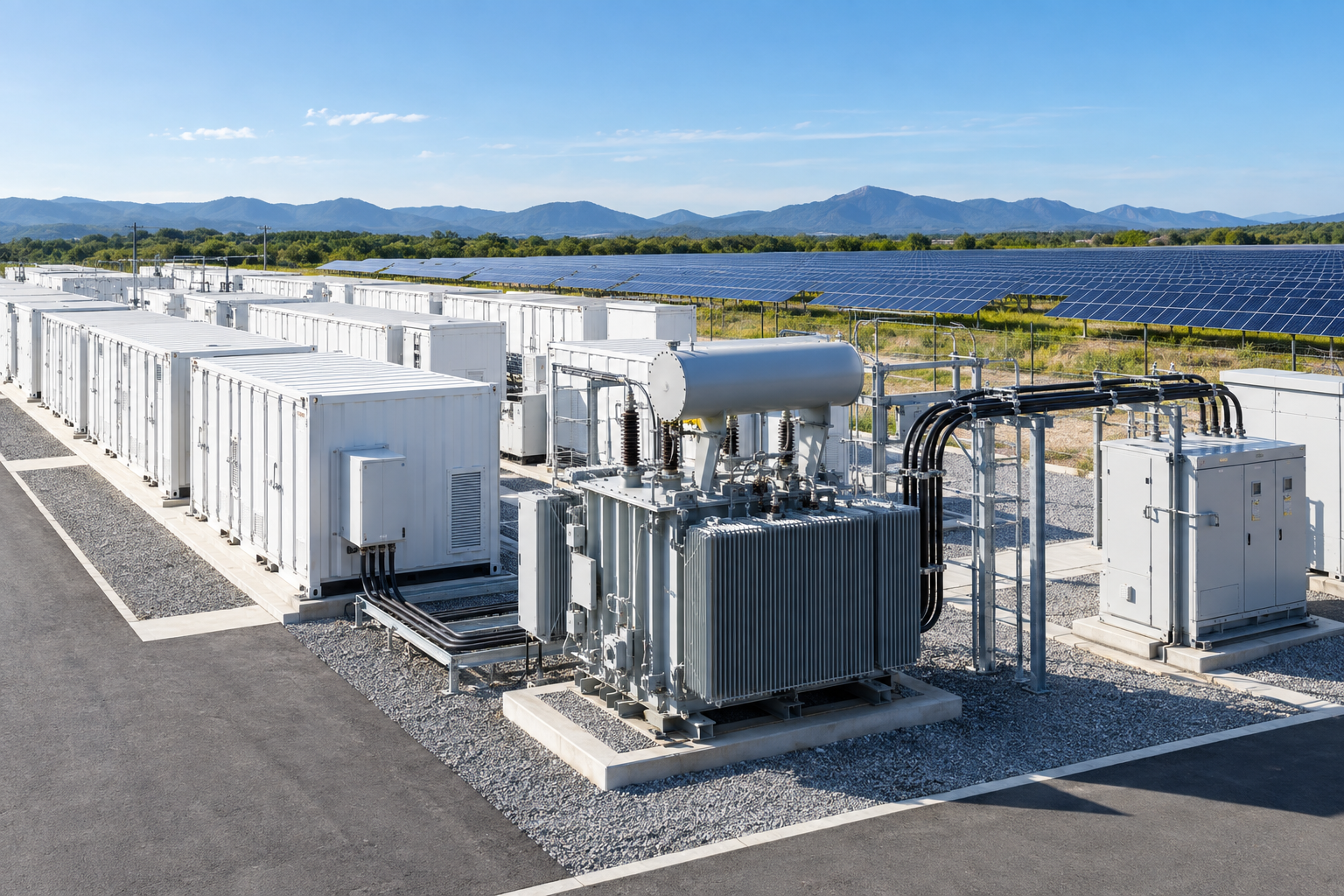
For electrical equipment buyers, this growth creates a specific engineering challenge: a battery energy storage system does not load its transformer in the same way as a conventional one-direction industrial load. Charging and discharging cycles, inverter harmonics and repeated changes in power flow must be considered together.
Why BESS Duty Is Different
A battery project may import power while charging and export power while discharging. The duty cycle can change several times per day, and operating strategies may be adjusted according to electricity prices, grid services or renewable generation. The transformer therefore needs to be evaluated for bidirectional loading, cyclic thermal performance and the actual inverter operating profile.
Inverter-based systems can also introduce harmonic currents and voltage distortion. These do not automatically make a project unsuitable for a standard transformer, but they do require the supplier to review loss calculations, temperature rise, insulation stress, audible noise and any derating that may apply.
Six Items to Put in the Transformer Specification
Power and energy profile: provide maximum charge and discharge power, expected duration, daily cycles and overload requirements.
Voltage and grounding: confirm inverter-side and grid-side voltage, vector group, neutral arrangement and grounding method.
Harmonic data: share the expected current spectrum and total harmonic distortion from the power-conversion system.
Impedance and fault duty: coordinate transformer impedance with fault levels, protection settings and the inverter manufacturer’s requirements.
Environmental conditions: state ambient temperature, altitude, enclosure, corrosion class and any fire-safety or fluid requirements.
Monitoring: define winding and oil temperature, pressure protection, cooling status, alarms and communication interfaces appropriate to project criticality.
Co-Located Solar and Storage Need Coordinated Design
EIA data show that many large battery systems are located with solar plants. Shared connection infrastructure can reduce project cost, but the transformer rating cannot be selected by simply adding solar and battery nameplate values. Engineers need a realistic simultaneous operating envelope, including whether the battery charges from solar, from the grid or from both.
The collector system, switchgear, cables, protection and main step-up transformer should be checked as one package. A transformer sized only for the initial operating mode may become a bottleneck when the plant later changes its charging strategy or expands its storage capacity.
Plan for the Operating Strategy, Not Only the Nameplate
The most reliable quotation starts with a clear single-line diagram and an operating profile agreed by the battery integrator, inverter supplier and grid-connection engineer. Early coordination allows the transformer manufacturer to confirm temperature rise, losses, insulation level, impedance and accessories before production capacity is reserved.
Les délais de livraison des transformateurs et les chaînes d'approvisionnement du réseau électrique resteront des facteurs importants en 2026. Passez en revue les caractéristiques électriques, les conditions d'installation, le rendement, la certification et la documentation que les acheteurs doivent vérifier avant de passer commande.
Les données publiées par le ministère de l'Industrie et des Technologies de l'information ont montré que la production de tous les maillons de la chaîne industrielle photovoltaïque a atteint un niveau record en 2022. La production de polysilicium, de plaquettes de silicium, de cellules et de modules en Chine a atteint...
Distribution-transformer efficiency, manufacturing capacity and material availability are again under review in the United States. In June 2026, the U.S. Department of Energy issued a request for information on how energy-conservation standards fo...
Avant de définir les spécifications de votre projet, comparez les transformateurs à sec et à bain d’huile en termes de refroidissement, d’installation, d’entretien, de sécurité incendie, de rendement et d’application.
 Catégories à la une











Envoyer une demande de renseignements sur un produit
Nous vous contacterons dans les 24 heures.